
Big Love
I suppose one could say it’s a little cliché to write about love so close to Valentine’s Day.
Call it what you will, but I can think of no greater topic to opine on today—and honestly, on most days.
To be clear, I’m not talking about doilies and red roses and heart-shaped boxes of chocolates. Not the sugary, performative love we’re sold in rom-coms and romance novels.
I’m talking about love—big love. Necessary love.
Love not as decoration, but as foundation.
Love as the answer to some of the hardest questions we face.
I keep noticing that when people ask the biggest questions—the ones that aren’t theoretical but existential—they don’t get clever answers. They get simpler ones.
People don’t usually begin by searching for love. They search for relief. For certainty. For a fix.
For something—anything—that will make the situation manageable.
I didn’t realize how true this was until life handed me a small - but insistent - lesson.
Anyone who knows me well knows that 2026 has gotten off to a bumpy start. I won’t give you the gory details—that feels self-indulgent—but I will offer one example, because it belongs here.
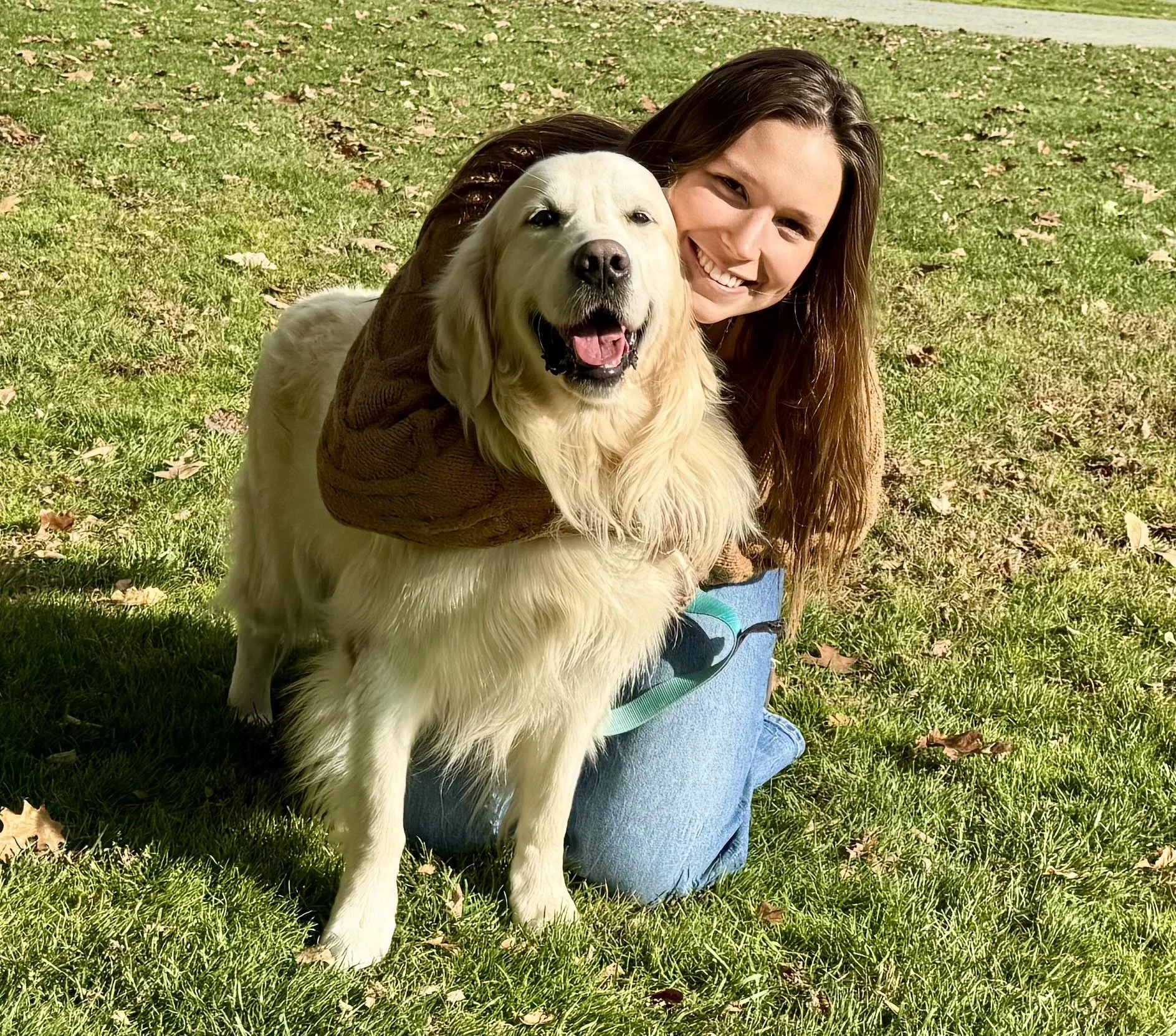
Our beloved six-year-old Golden retriever Sailor - sweet, affectionate, and definitely not the smartest in the litter—started having seizures in January. Medication helped…until it didn’t.
The seizures returned. More medicine, more seizures.
Sailor became frightened and agitated, no longer himself. Watching him was heartbreaking—the confusion, the fear, the way his big, gentle body no longer felt safe to him.
I did what I know how to do best - I ran around picking up various meds, adjusted, waited, hoped. I was looking for the best answers medicine could offer.
Then one night—very early morning, really—he climbed onto my bed and curled into my lap.
He is far too big to be a lap dog, but there we were. I held him, and we just looked at each other.
I was exhausted. He was unsettled.
And still, we stayed.
It didn’t occur to me until that moment that maybe what he needed most wasn’t another solution.
Maybe he just needed love.
I see this instinct to fix—to smooth, to clear the path—show up elsewhere in my life.
I pride myself on being a prudent and knowledgeable mom (the kind that has read every how-to mom book out there).
But, if I’m being completely honest, what comes most naturally to me is what psychologists politely label the snowplow. Sometimes the lawnmower. Occasionally the bulldozer.
I like to fix things. Or, maybe more accurately, I’d prefer there be no problems at all. Smooth sailing. Clear skies. No unnecessary hardship for my children.
And yet, it’s incredible what happens when I have the wisdom to put duct tape over my mouth and just listen.
When I don’t solve. When I don’t rush ahead. When I don’t clear the path.
Something softens.
Not the situation, necessarily. But the space around it. The person in front of me. And often, me.
That softening shows up far beyond my own small life.
Michael Pollan didn’t set out to write about love, either.
In How to Change Your Mind, he went looking for neuroscience—for data about depression, addiction, anxiety, and why the mind can become so rigidly stuck.
Much of his reporting follows the careful, clinical use of psychedelics in therapeutic settings, where researchers noticed something unexpected. What emerged was not a tidy answer so much as a pattern: when the ego quiets—when the self loosens its grip—people feel connected.
They describe being held. They forgive. They soften.
Pollan is careful in how he names it. He doesn’t romanticize the experience or claim it solves everything. But he does observe that what people often encounter in these moments of connection feels unmistakably like love—not the sentimental kind, but a steady sense of belonging. And he notes that people heal in connection, and they suffer in isolation.
Which turns out not to be a modern insight at all.
Decades earlier, under unimaginably harsher conditions, Viktor Frankl noticed the same truth. Watching people lose everything—names, homes, futures—he saw that survival often hinged on love.
Someone to love. Someone to hold in the mind. Love as orientation when meaning itself was under threat.
The pattern repeats at scale.
Martin Luther King Jr. reached the same conclusion through conflict rather than confinement. Law and protest mattered, but hatred could not end hatred without reproducing itself. Only love could interrupt the cycle without destroying what it aimed to heal.
And Desmond Tutu, facing a nation fractured by cruelty, understood that punishment alone would never be enough. Forgetting would deny the truth. The only path forward insisted on shared humanity—love tethered to honesty.
Different lives. Different stakes. The same conclusion.
And then there is my own mother.
Today she would have been 85. I miss her.
She wasn’t always the easiest person - positive reinforcement was not her middle name. Toward the end, she had very little energy to engage, and conversations could feel thin, abbreviated.
But what I miss most is not her advice. It’s her presence.
Having her at the other end of a phone line. Just knowing she was there. Willing to listen while I gave updates about the children—the ordinary ones, the proud ones, the slightly worried ones. Watching her make the effort, even when it wasn’t easy, to show up for graduations, birthdays, celebrations. Sitting in folding chairs. Waiting things out.
Being there.
There was comfort in that, though I didn’t fully understand it at the time. I was still looking for answers and judging her (although I hate to admit it). Still assuming love announced itself more clearly.
I understand now. Too late, perhaps—but clearly.
What love had been doing all along. Not as the first conclusion, but as the last one standing.
Not fixing. Not reassuring. Not improving.
Just staying. Just listening.
Just being there.
And it’s hard not to notice how much our world needs more of this kind of love right now.
We live in a time that rewards certainty and outrage. We argue to win. We speak to be heard. We rush to fix, correct, cancel, move on.
Listening feels inefficient. Staying feels risky. Presence feels almost radical.
And yet history, science, and personal loss keep pointing to the same truth - without this kind of love, nothing really heals.
So, if Valentine’s Day arrives with its roses and chocolate, enjoy it!
But I hope we can remember this version too—the quieter one.
The kind on the other end of the phone line. The kind that seeks connection. The kind that holds a frightened dog in the middle of the night. The kind that doesn’t announce itself, but endures.
Because when all the answers run out, love is what remains.