
rien n’est joué
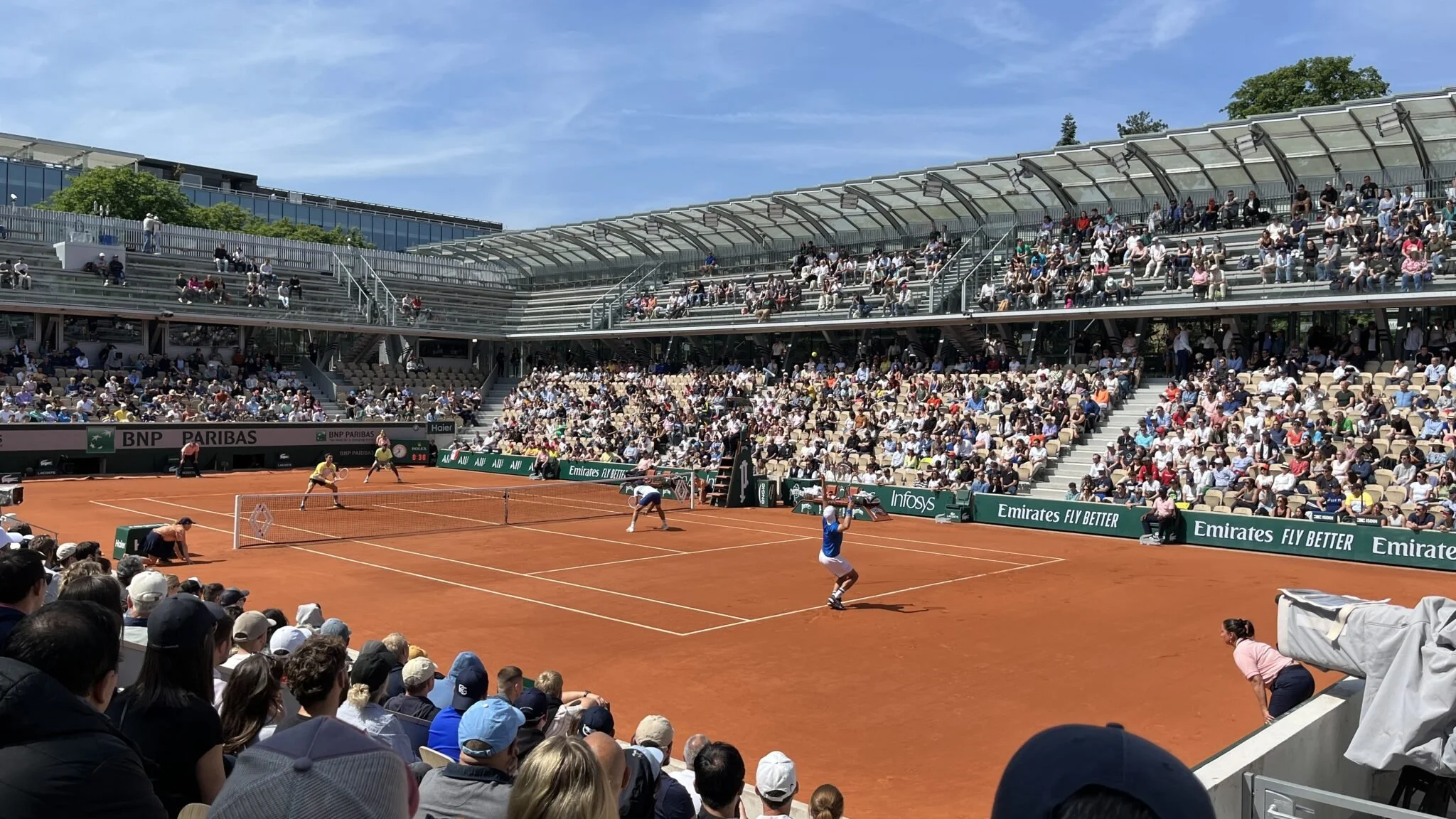
I checked an item off my bucket list last week and spent two days at the French Open.
It felt good to check that box - one that had been sitting quietly, almost forgotten, on my list for years. And the experience far exceeded my expectations.
I expected to be amazed by the tennis (and I was). But what I did not expect was to come home with lessons (and an orange Roland-Garros cap).
There they were, though, tucked between the red clay, the white lines, the polite applause, and the sudden roar of the crowd - lessons in pressure, resilience, grace, heartbreak, mindfulness, and the strange beauty of starting over.
Paris reminded me that sport is never just sport. It is courage. It is momentum lost and found. It is the discipline to stay steady when the score says otherwise. It is the humility of beginning again - a new point, a new game, a fresh set.
And although I have watched a lot of tennis over the years, it was in France that I truly appreciated that at 40-love - or two sets down - great players do not give up.
They go for broke.
Forty-love sounds definitive. It sounds as if the point is over before it is actually over. As if the person ahead should relax and the person behind should quietly accept defeat.
But that is not what happens.
The great players do not seem to believe in “almost over.” They dig in. They return the ball with the same power as if they were ahead, not behind.
We saw that spirit all over Roland-Garros. Alexander Zverev, after years of near misses, finally won his first Grand Slam title in a five-set final against Flavio Cobolli. Cobolli, in his first major final, forced a fifth set and refused to disappear. Nineteen-year-old João Fonseca came from two sets down to beat Novak Djokovic, which sounds almost impossible until you remember that sport has a way of making room for the impossible.
Do not allow the score to convince you that the game is over.
I know, personally, that when the chips are down - when I have screwed up, when I feel overwhelmed, when the outcome seems all but certain - my instinct is often to retreat. To get quiet. To brace for the loss before it has even arrived.
And this does not only happen on a tennis court.
It happens in relationships. In board rooms. Around dinner tables. In hard seasons when life seems to be keeping score, and the score does not appear to be in your favor.
But maybe the question is not, “Am I winning?” Maybe the better question is, “Can I stay in the point?”
Sometimes that is enough.
Stay in the point. Return the next ball. Do not let up.
And wow - these athletes hit the ball incredibly hard, but somehow remain in full control.
The power is almost shocking up close. The speed. The sound. The force of it. These players are not tapping the ball gently into the Paris afternoon; they are absolutely crushing it.
And then, just when you expect another blast across the court, they mix it up with a perfectly timed drop shot - soft, precise, and touched with just the right amount of spin.
Within all that power, there is discipline. Precision. Restraint. Control.
Power without control is just chaos. But controlled power - that is something else entirely.
There are moments when we need to know when to place the ball instead of punish it. When to trust timing more than force. When to stop swinging harder and start aiming better.
Strength is not always about volume. Sometimes strength is restraint. Sometimes it is softness. Sometimes it is knowing exactly where to put your energy.
My husband would say I love to cheer loudly.
Or, more accurately, he would say nothing and simply place both fingers in his ears.
But, honestly, I have nothing on the French.
Yes, the French are reserved, sophisticated, elegant. But at Roland-Garros, they are also wonderfully, gloriously enthusiastic.
They clap. They cheer. They rise to their feet. They do the stadium wave - repeatedly. They appreciate effort, artistry, drama, and nerve. They celebrate the underdog, the brilliant shot, the long rally, the player who refuses to quit.
And, of course, they celebrate their own players most of all.
There is something intoxicating about watching an engaged crowd recognize greatness in real time. They see effort and they honor it. They see someone hanging on by a thread and they help carry them forward.
Although my husband may prefer a slightly lower volume, I think we could all learn something from that.
We need to cheer more. Generously. Happily. With vigor.
For the people we love. For the people trying hard. For the ones who are behind but still swinging. For the ones who need to hear, just when they are tempted to quit, that someone still believes they can stay in the point.
Roland-Garros also showed me that sportsmanship is alive and well.
In a world that can feel increasingly loud, rude, and divided, there was something deeply moving about watching competitors behave with such grace. They fought hard. They wanted to win - you could see it in every point, every sprint, every grimace, every clenched fist.
But they also tapped their racquets in appreciation of a good shot made by their opponent.
And at the end, they met at the net.
A handshake. A nod. Sometimes a hug.
We could use more of that everywhere.
Fight hard for what matters, but meet at the net when it is over.
And, of course, when in France, eat French bread, sweet butter, cheese, and foie gras.
This may not be the deepest lesson, but it is possibly the most delicious.
The French seem to understand pleasure better than we do. They linger. They savor. They sit at tables. They eat real food. They do not appear to be walking down the street drinking a sad protein shake while answering emails.
They make room for pleasure.
And maybe that is not indulgence as much as wisdom.
Eat the bread. Use the butter. Taste the cheese. Notice the moment. Be where you are.
So yes, I went to Paris to watch tennis.
But I returned to Connecticut with something more - without the breadbasket, unfortunately, which I was forced to leave behind.
I came home with the memory of extraordinary athletes on red clay and with a reminder that the score is only part of the story.
Our story is what we do next.
How we return the ball.
How we use our power.
How we cheer for others.
How we lose.
How we win.
How we meet at the net.
And also, how we receive the moment while we are in it.
How we notice the beauty.
How we savor the cheese.
How we stop rushing long enough to realize we are sitting inside something we once dreamed about.
And how, even when life says 40-love, we remember that the point is still ours to play.