
The Story Beneath The Medal
Please do not interrupt me. I am very busy.
Very busy watching the Olympics from beneath a heated blanket on our family room couch — an elite athletic position requiring exceptional snack endurance and strategic remote placement.
While these athletes have trained for years at altitude, I have prepared by adjusting throw pillows and holding my breath during slow-motion replays.
Still, I am in awe.
The speed. The jumps. The grace. The kind of strength that makes you question whether you have ever truly committed to anything in your life.
I sometimes wonder which Winter Olympic sport I could attempt and survive.
There is patriotism, too. Watching the flag rise. Hearing the anthem.
Feeling, briefly, a shared pride that doesn’t require commentary. We need that right now — moments when we can clap together without first checking who someone voted for.
But what undoes me every time are not the medals. It’s the stories.
A docuseries on Olympic ice dancing unexpectedly captivated me. Suddenly I wasn’t watching choreography - I was watching grief, love, and survival.
Piper Gilles skating through the loss of her mother and her own cancer diagnosis. Madison Chock and Evan Bates moving with trust built over years.
And beyond Netflix, there are other stories too.
Maxim Naumov honoring his parents killed in a plane crash. Nick Baumgartner funding his dream while living in a van.
The backstory changes everything. It enlarges the moment; it tugs at empathy.
Growing up, my sister went to two Olympic swimming trials. I saw the early morning practices. The discipline. The smell of chlorine before sunrise.
She never made the team, but knowing her story forever changed how I see swimmers step onto the blocks. How I see all Olympians, really.
Stories do that.
When we hear emotionally grounded narratives, our brains release oxytocin — the chemical that builds trust and connection. Stories move us past labels and into shared humanity.
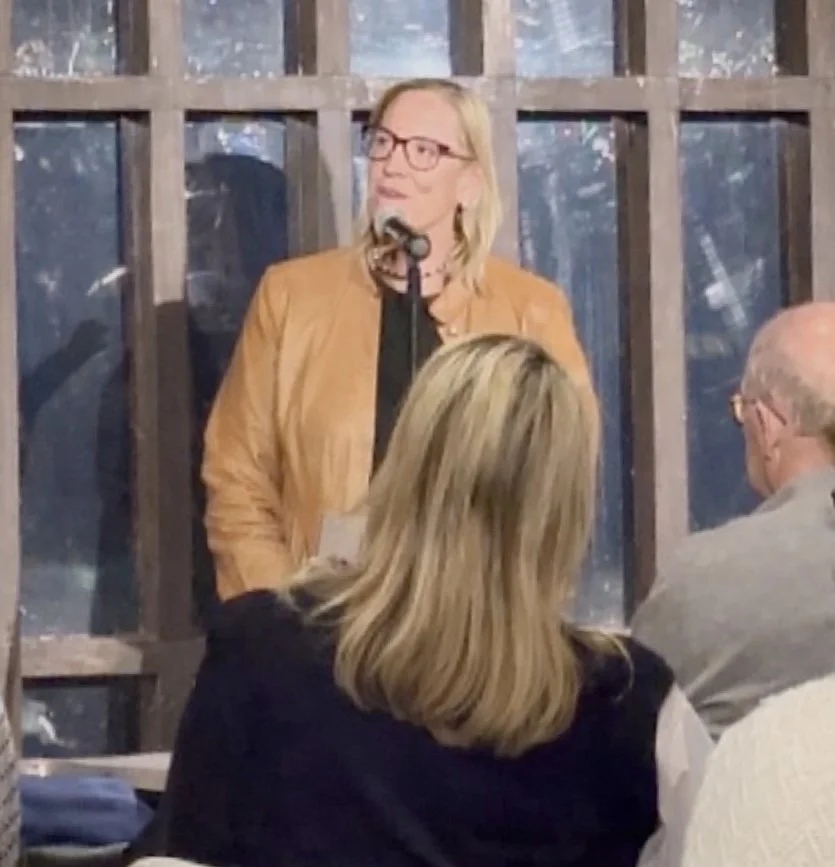
Last year, I stood on a stage (terrified) at a local storytelling event inspired by The Moth, whose mission is to celebrate the diversity and commonality of human experience through true stories told live and without notes.
The theme was “calling.” Mine was simple - stay sober and help another alcoholic.
For 37 years I have told that story in 12-step rooms. What I have learned is this - when someone speaks honestly about fear or failure, something shifts.
Not agreement.
Recognition. Compassion.
I once listened to an elderly man describe riding his motorcycle across state lines after a relapse — wind in his face, shame in his chest.
I have never ridden a motorcycle across state lines; I am not an old man.
But I knew the shame.
And in that knowing, the gap between us closed.
Which may be why Theo of Golden by Allen Levi lingers with me.
Theo purchases portraits — ordinary faces rendered by a local artist — and sets out to find the subjects and gift the paintings to them.
And in doing so, he listens.
The portrait becomes an invitation — not to admire a face, but to honor a life.
Theo isn’t collecting art as much as he is collecting stories.
There is a line in the book that feels almost like a challenge - “Who is that person? What do I know to be true, really true, about that face?”
That question is not passive; it requires time. It requires pursuit.
It is the same question we ask when we learn an Olympian’s backstory. The same question I asked watching my sister step onto the pool deck years ago. I knew what those early mornings had cost her.
Because I knew her story, I saw her differently.
When I heard that David Brooks would be stepping away from his long run at The New York Times, I felt a surprising pang. Not because I always agreed with him, but because he has spent years urging us toward this very posture — to truly see another person. In How to Know a Person, he calls deep listening a moral act.
And maybe that is why the Olympics resonate.
For two weeks, we practice curiosity over caricature. We cheer for athletes from countries we cannot locate on a map. We grieve with a skater honoring his parents. We admire sacrifice that predates the spotlight.
And because we know their stories, we care.
Not about race or religion or party affiliation — but about the person. The human being standing there. The life beyond the uniform.
Unity does not begin with consensus. It begins with curiosity, with the willingness to ask, “Who is that person, really?”
But listening is only half of it - someone has to be brave enough to tell their story.
An athlete carries grief onto the ice. An elderly man admits shame. My sister stands on a starting block after thousands of silent laps. A woman steps to a microphone and says, “Here is my truth.”
When we share our story honestly, we offer a bridge.
When we listen generously, we cross it.
And what a gift.
So please excuse the late emails, the missed calls. I am very busy.
I will continue my rigorous training — positioning pillows and adjusting the volume - until the closing ceremony.
But what I am really practicing is this:
To tell the truth when it is my turn.
To listen well when it is not.
To honor the life beneath the medal.
Peace may not be built in grand speeches or perfect agreement.
It may be built quietly - between one story told and another heart willing to receive it.
Even from beneath a heated blanket.
Even here.